NPC–SS Trains Security Personnel and Journalists in Ruweng Administrative Area
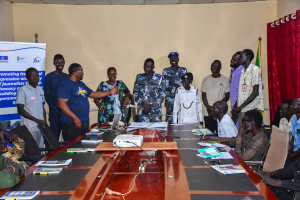
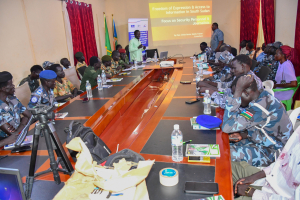
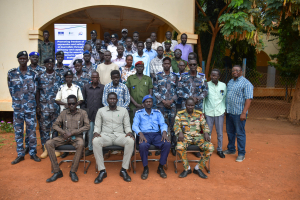
The National Press Club – South Sudan (NPC–SS) Conducted a two-day workshop dialogue on freedom of expression, access to information, and the safety of journalists on 24 and 25 of September 2026 in Panrieng, Ruweng Administrative Area.
Centered to the theme “Promoting Freedom of Expression and Safety of Journalists through Advocacy and Capacity Building for Security Personnel in South Sudan,” the workshop convened over 30 security personnel from the different Police units, members of the National Security Service, South Sudan People’s Defense Forces, and ten journalists working for various media house in Ruweng.
Mr. Paul Jimbo, the lead facilitator explored sessions on freedom of expression and access to information, communication with media during high-pressure situations, South Sudan’s media laws, media interviews, and protecting journalists during public order. These sessions were delivered through a participatory approach enabling in-depth interaction that remain a fiber for improving the work-relationship between journalists and security personnel, especially during this critical electoral period.
In his closing remarks, the Secretary General (SG) of Ruweng Administrative Area, Hon. Kotjang A. Deng underscored that the media is the fourth arm of the government, “Media is the fourth authority, and it has the highest voice over all the other authorities. That is why in any event, if there is no media, that event cannot be seen by other people, and this attests to the power of the media.” The SG further noted that these days, almost everyone with a phone wants to be a journalist, he emphasized the need for continued training to strengthen professionalism and ethics. Hon. Kotjang encouraged the participants to reflect on the knowledge, “go and review the things that you have learnt, you can also advance your knowledge through the internet as well as by sharing among yourselves as you have now become friends.” He further called for professionalism among security personnel emphasizing on friendly engagement with journalists as discussed during the workshop. Kotjang thanked the partners for conducting the event in Ruweng, and stressing the need for more workshops.
On his part, the Director General in the Ministry of Information and Communication, Hon. Chol Charles appreciated NPC-SS, UNESCO and JICA for the meaningful initiative. Chol noted that bringing journalists and security personnel together is a unique approach that can positively build lasting relationship between the two actors of the state. He appreciated the participants for their patience and asked them to reflect the knowledge in the field.
Mr. Nyok Luk who represented the journalists, said “The truth is that we have benefited a lot from this workshop – among others, we learned how to build a healthy relationship between the journalists and security personnel,” adding that these two sides can work together. Nyok stressed that the two days were short but very impactful. He encouraged his colleagues to apply the knowledge and refrain from taking sides, “we need to be straight, and avoid bending to the right or left,” he said.
Anthony Majok, representative of security personnel, said the two-day workshop have cemented a good relationship between them and the journalists. “This two-day workshop has brought us together and we have learned about our different responsibilities.” “No one will again interfere in another’s work without fully understanding the situation,” he added.
This training builds on a UNESCO-led Training of Trainers held in Juba in June 2026 and is supported by JICA South Sudan. This comes third in a schedule of seven trainings in seven different locations. NPC–SS and its partners will continue to strengthen the media landscape by fostering dialogue and practical cooperation between the press and security institutions to achieve a conducive environment for the media during and beyond the elections.